Welcome to our new site!
If you had an account with us on our previous site, you'll need to reset your password here.
Close this alert

Welcome to our new site!
If you had an account with us on our previous site, you'll need to reset your password here.
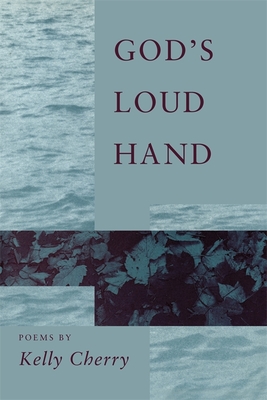
If religious poetry may be thought of as a great river fed, in the English language, by two main streams - the devotional tradition, leading in recent times to Anne Sexton and John Berryman, and the contrastingly philosophical tradition, exemplified by William Blake - it is to the latter that this new book by Kelly Cherry belongs. In the poems of God's Loud Hand, Cherry conducts - often not at all devotionally, often with an honesty that precludes the emphasis on self that tends to be present in devotional poetry ("Lord save me, " "Lord forgive me, " "Lord help me") - a metaphorical investigation of theological ideas. These are fiercely intellectual poems, which, in the way of T. S. Eliot, are more akin in their stringent analysis to Tillich or Niebuhr, perhaps, than to someone like Simone Weil. At their base is a willingness to ask Abraham's great question, "Shall not the Judge of all the earth judge wisely?" This intellectual boldness reveals itself in a formal argumentation rare in contemporary poetry. Lik Donne or Hopkins, Kelly Cherry defines her terms, orders her points logically - no vagary or sentimentality appears here. The result of such exactitude is a kind of clarity, a grace, that seems to lift the poems off the page, to cause them to rise, make their own kind of ascension. It is as if these poems were larks - an exaltation of larks, as they say - that rise each morning to heaven's gate, but instead of singing hymns, they sing philosophy's own music. And in what a remarkable variety of keys, what a range of modes and moods. From the opening poems of historical and mythological drama, through the passionate love songs of the second section, through the dark night of the soul that takes place in the third, to the orchestral outburst of the final group of poems - poetry celebrating its own freedom to be poetry - in all these parts ("a chorus of lyrics, " one might say) there is a symphonic unity that astonishes, an ode to joy.